
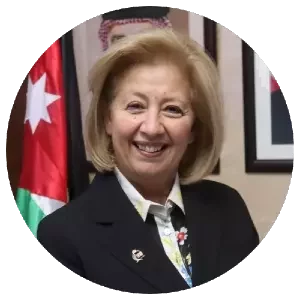
Parenting the AI Generation Forum Speaker Profile
H.E. Mrs. Haifa Najjar
H.E. Mrs. Haifa Najjar is a Jordanian educator, public servant, and cultural leader who has served as Jordan’s Minister of Culture while building a long career in educational leadership. She is widely recognized for her work in advancing educational reform, promoting cultural dialogue, and supporting civic engagement in Jordan through both public office and the education sector.
Career Highlights
Mrs. Haifa Najjar spent decades leading the Ahliyyah School for Girls and the Bishop’s School for Boys in Amman, where she became known for encouraging innovation in education and learner-centered teaching. She also launched the Tanweer (Enlightenment) Movement, an initiative focused on educational renewal and critical thinking. Alongside her educational work, she served in the Jordanian Senate across multiple terms before joining the government as Minister of Culture.
Public Service and Educational Philosophy
Mrs. Najjar’s public roles have extended beyond schools. She has served on the Greater Amman Municipality Council, the Economic and Social Council, and several international educational bodies connected with the International Baccalaureate (IB) and the European Council of International Schools (ECIS). Her work consistently emphasizes lifelong learning, cultural openness, community participation, and the role of education in strengthening society.
Recognition
Over her career, Mrs. Najjar has received numerous national and international honors for contributions to education and public life. These include Jordan’s Order of Al Hussein for Distinguished Contributions, the King Hussein Award for Academic Excellence, the French Légion d’Honneur, Spain’s Order of Civil Merit, the ECIS Award for the Promotion of International Education, and the Lanfranc Award for Education and Scholarship presented by the Archbishop of Canterbury.
Areas of Impact
Mrs. Najjar's influence is most closely associated with:
Educational leadership through school administration and reform initiatives.
Cultural policy as Jordan’s Minister of Culture.
Youth development and civic participation.
International education, particularly through leadership roles within IB and ECIS organizations.
Women’s leadership, including advocacy for greater participation of women in public life and decision-making.